- The Consumer OC
- Posts
- Seize the Means of Produce!
Seize the Means of Produce!
The Birth of the Produce Section

Gunnar Maples
December 20, 2025

Written by Gunnar Maples, with contributions from Blake Williams
Walk into a grocery store, and what do you see? The abundant produce section. Brussels sprouts and broccoli, in winter’s fashion, adorn their royal green. Apples of perplexing variety are stacked in pyramids. Potatoes, onions, garlic, and carrots beg to be thrown in a pot. These products don’t need marketing. They are beautiful on their own.
Looking back in time, though, we didn’t always have a produce section. What got us to this cornucopia of avocados, beets, and cauliflower? And more importantly, where are we going? What does the modern consumer want in their produce section? Let’s turn back the clock before any of us were born…to the year 1900.
Scouting Report
A Brief American History of Produce
Before World War I, households used kitchen gardens to provide herbs, fruits, and vegetables for their diets. An example layout of a kitchen garden is shown in the figure below.

In colder climates, root cellars stored hardy crops like potatoes, carrots, and onions, while non-hardy produce was often jarred. Even when fresh, many of the fruits and vegetables consumed were still boiled, pickled, or otherwise preserved to prevent food-related illnesses.
Fun fact: this is why pies are so popular in America. European colonialists were required to plant apple and peach trees over a three-year period before a land grant was issued. The result: hard cider and pie in the early American diet!
While there was no large marketplace for produce, early refrigeration was introducing exotic novelties (an imported orange on Christmas was a treat!) to local markets. This changed with WWI.
Vitamins in produce were identified as beneficial to our health in 1918 with Elmer McCollum, a Yale University nutritionist, claiming that milk, fruit, and vegetables were critical for preventing specific diseases and promoting a healthy life. This increased demand for fruits and vegetables. By the 1930s, local supermarkets started to feature the “convenience” of picking your own produce instead of relying on the grocer behind a counter to offer you what they wanted/were able to stock.
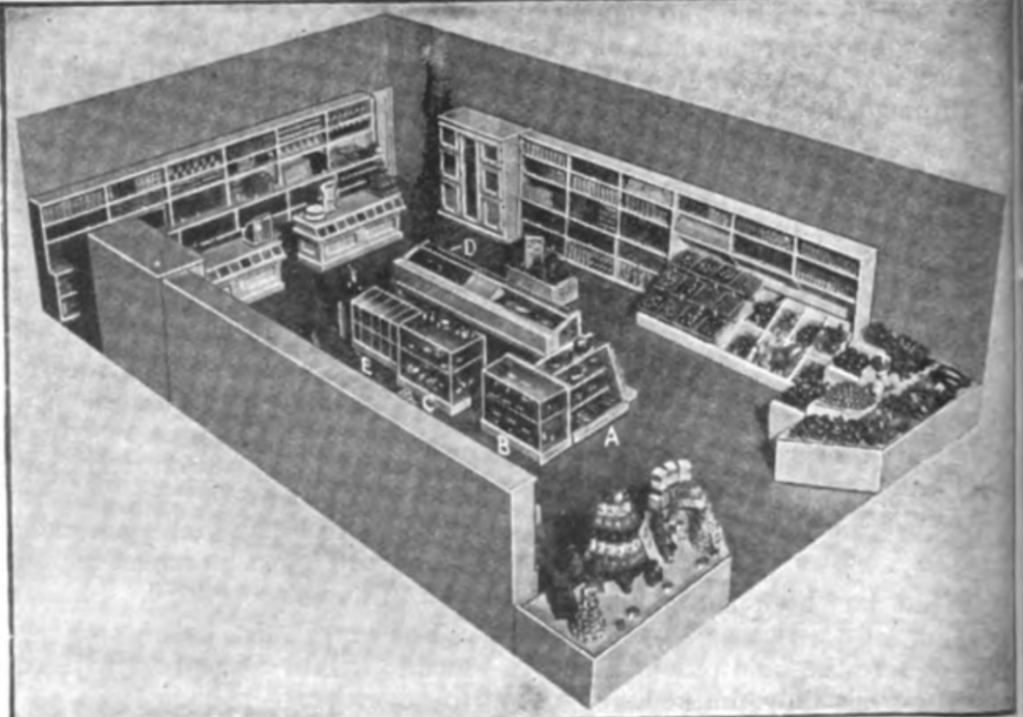
This tendency toward supermarket produce shopping was curbed during the financial distress of the Great Depression through relief gardens. Gardening was further incentivized with the resource demands of WWII. Fresh produce was never rationed, but citizen-grown Victory Gardens were promoted by the U.S. government to increase the food supply.
Around 20 million families planted these gardens and produced 40% of U.S. vegetables by 1944, which was an aggressive adoption of what is now called Urban Agriculture. WWI and WWII drove significant technological change, and a fascinating result is that fresh produce was enjoyed at scale (instead of boiling or preserving everything). Thank you, science!

The U.S. played a key role in securing the Allied victory during World War II, and with the postwar shift of power came economic prosperity. Victory Gardens were neglected and convenience became a priority. Nationwide supermarket chains became an American staple and the once-exotic orange on Christmas was no longer novel. Pineapples could be purchased year-round!

Combine the shift towards convenience with the rise of fast-food in the 1950s, and you are left with a reduction in produce in the American diet. Vegetables (often canned) were hidden in casseroles.
Interestingly, in this time period the public was very sensitive to marketing. Aggressive campaigns by producers gave rise to the popularity of the Red Delicious apple and the banana. It seems the vacuum of no gardening left the consumer sensitive to influence.
Health movements at the end of the 20th century brought produce back into the limelight. Partially due to poor health habits with the introduction of fast food (and casseroles), the USDA Dietary Goals of 1977 began recommending fruits and vegetables for Americans. Salad bars were popularized in the late 70s, reflecting a growing demand for vegetables in the American diet.

New technology assisted this shift. The rise of the Interstate Highway System in 1956 and refrigerated trucking turned California’s central valley and Florida’s farmland into producers for the nation, not just the local regions. International produce became more available through globalization. The microwave (common by the 1980s) helped rapidly steam frozen vegetables and pre-packaged fresh produce introduced convenient snacking.
With the start of the 2000s, the adoption of produce evolved with the significance of the organic market. Consumers began to value the way produce was prepared, rather than only what it was. However, this is where socioeconomic and demographic differences of the consumer become distinct. Produce in the U.S. was only to be found in grocery stores or supermarkets. As modern corporations identified the best locations to position themselves, inequitable patterns developed. Higher-income, urban communities experienced abundant selection from competing brands while lower-income, rural communities experienced food deserts where fresh produce was prohibitively expensive or difficult to find. These lower-income communities instead relied on lower-cost ultra-processed foods.
Modern Day and Brand Design
This above history lesson is brief, but modern consumer preferences are not created in a vacuum. They are a function of the past, a mosaic of influences, choices, and traditions that manifest in the now. The socioeconomic and demographic differences that were exacerbated with post-WWII globalization, the dot-com boom, the 2008 recession, the COVID-19 pandemic, and now the AI bubble are only growing in the U.S. As a business selling produce, I would be concerned about brand design in my community and how to best nourish different demographics.
Americans have shown resilience in the 1930s recession and 1940s wartime to feed themselves with urban agriculture. As businesses and consumers navigate post-COVID inflation and economic uncertainty, increased pressure on household budgets is likely to heighten price sensitivity and constrain produce purchasing among lower-income consumers.
If I was targeting lower-income consumers, I would explore low margin offerings that introduce produce to the lower-income diet focusing on convenience, value, and flavor. As a brand, I would be the hearth; produce should help consumers create safety and strength in their home. Thereby prioritizing nourishment, reliability, and value over symbolic labels, brands can reveal tangible benefits rather than performative signals. Another interesting opportunity would be partnering with local farms, non-profits, or community gardens to offer low-cost or free produce to these communities and educate them on how to start growing some produce at home.
For the high-income consumer, the experience of produce shopping should be a walk through the Garden of Eden. This customer is expecting excellence from the quality and flavor of their produce and the convenience of selection. Shopping to this consumer, in person or online, is like a charade; as the Garden of Eden is a parable, so too should the shopping journey walk like a story. The customer should exit with destiny - like the food they are eating was “meant to be”. This means there must be a balance between “the search” and the expectation of instant gratification.
For the mid-income consumer: choice is more relevant. The option to select higher-quality produce should be obtainable but not the norm. Higher quality could mean ethically and responsibly grown produce (e.g. organic, fair-trade) or a feature variety (e.g. Honeycrisp apples). This group, a tension of demographic extremes, also experiences the tension in decision making. Options are necessary so the individual, on a specific day, in a unique mood, has the opportunity to make a decision that fits best with them. Without this choice, the consumer could be frustrated at their choice of grocery store. In a crowded market, that may mean a grocer should specialize. In a sparse market, produce diversification could attract.
Notice this article does not dive into modern shopping methods like grocery store pickup/delivery or unique produce opportunities like CSAs (Community Supported Agriculture) for local farmers markets. Look forward to the next article focusing on how modern produce shopping can be designed to help businesses and consumers!